Haazri
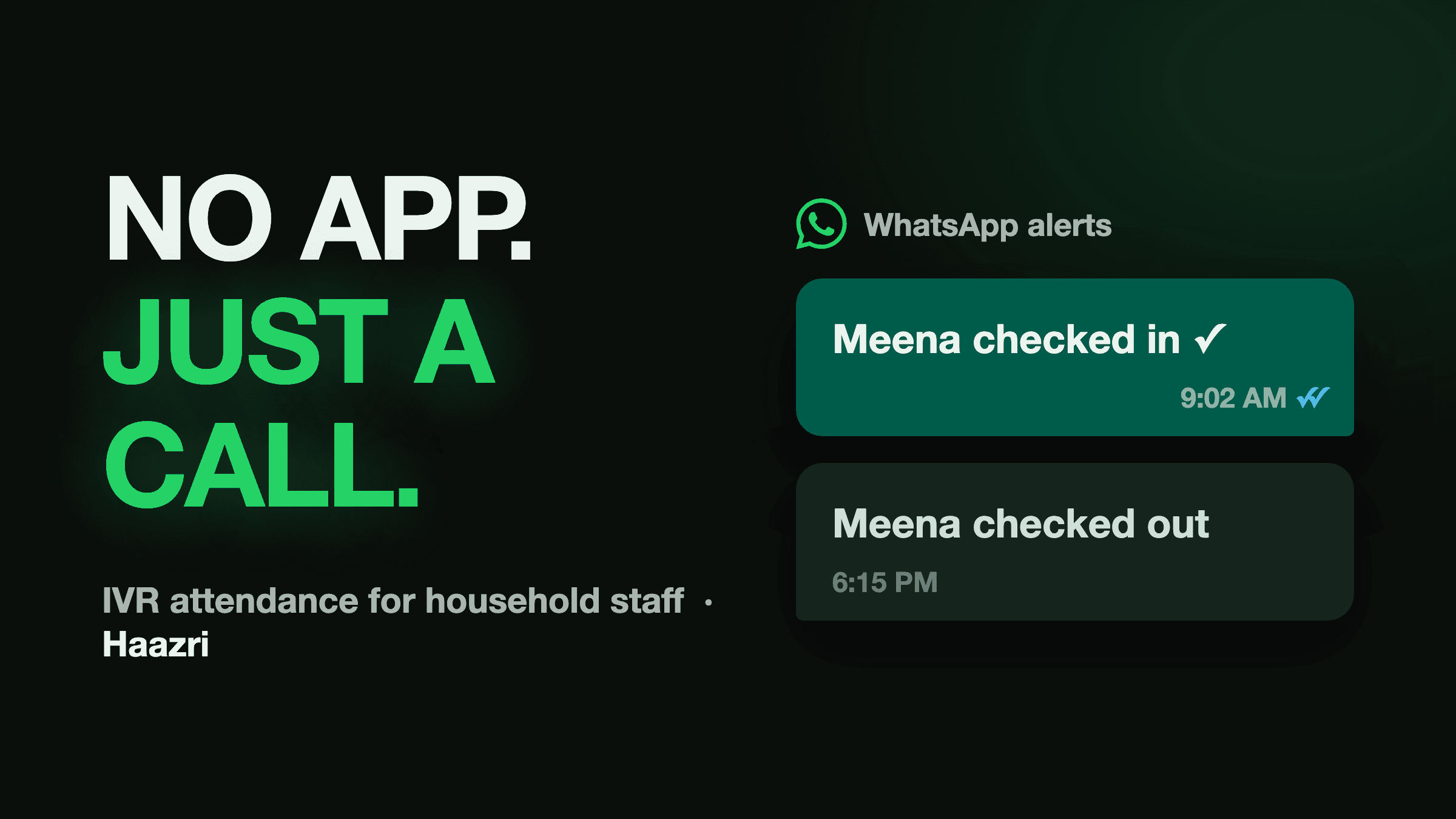
IVR-based attendance for maids and cooks — workers call a virtual number from the client's home and entry/exit gets logged automatically, with instant WhatsApp notifications to the client via the WhatsApp Cloud API. No app needed.
The problem
Household staff in India — maids, cooks, drivers — mostly don't use attendance apps. Many use basic phones; even smartphone users won't install an employer's app for a job at one house. But everyone can make a phone call. Haazri turns a missed-call-style IVR flow into an attendance system.
How it works
- Each client household gets a virtual phone number and a unique ID.
- When the worker arrives, they call the number from the client's home; the IVR flow logs the check-in against that household — no app, no login, nothing to learn.
- Check-out works the same way when they leave.
- The client instantly gets a WhatsApp message — "Meena checked in · 9:02 AM" — via the WhatsApp Cloud API, with entry/exit history available on demand.
The beauty of the model is that the worker's cost of participation is one phone call — a gesture they already understand — while the client gets a verifiable, timestamped log.
Build notes
Node.js and Express on the backend with MongoDB for households, workers, and attendance events. The two integration surfaces were the interesting parts:
- IVR/telephony webhooks — call events arrive as webhooks; mapping raw call metadata to the right household and deduplicating retries taught me a lot about designing idempotent webhook handlers.
- WhatsApp Cloud API — template-based notifications with delivery tracking. Getting message templates approved and handling the API's error modes was its own education.
What I learned
Products for non-tech-first users flip every default assumption. The best interface here wasn't an interface at all — it was a phone call. Meeting users at the technology they already trust beats teaching them yours.